Free International Delivery
On Orders Over $200*
How a Kashmir Pashmina Shawl is Made — The Complete Process | Pure Kashmir
Ancient Craft of Kashmir

How a Pashmina Shawl
is Made by Hand

From the high-altitude plateau of Ladakh to the handlooms of Srinagar — a journey of 12 kilometres of walking, months of skilled labour, and five centuries of unbroken tradition.

Watch the Process

The Art of Kashmir Pashmina Weaving

A Tradition Unchanged Since the 15th Century

Cashmere takes its name from the old spelling of Kashmir — "Cashmeer". Pashmina means "gold wool" in Persian, the name given to the cloth woven in the Kashmir valley from the finest undercoat of the Changthangi goat.

The weaving process was developed in 15th-century Kashmir and has remained essentially unchanged. Every shawl passes through the hands of multiple master craftsmen, each responsible for a single stage of a journey that can span months.

15C Origin of the craft
12km Walking to lay one warp
1,200 Threads per warp
3–4 Days to weave one stole
Changthangi goats being herded on the high-altitude Ladakhi plateau at 4,500 metres above sea level Step 01
The Source

Herding the Changthangi Goat at 4,500 Metres

The journey of every Pashmina shawl begins not on a loom but on a high-altitude plateau. Changthangi goats are raised at 4,500 metres above sea level in the Changthang region of Ladakh, where winter temperatures drop to near-Siberian lows.

To survive this extreme cold, the animals develop a remarkably fine, warm undercoat beneath their thick outer fur. It is this undercoat — pashm — that is collected by herders each spring as the weather warms and the animals naturally shed it.

Kashmiri term Pashm — the raw undercoat fibre, measuring 12–16 microns in diameter
Raw cashmere pashm fibre being separated and dehaired by hand in Kashmir Step 02
The Fibre

Collecting & Separating the Raw Pashm

Once collected, the raw pashm is carefully separated from the coarser outer hair by hand — a process called dehairing. This separates the ultra-fine cashmere fibre from the coarser guard hair that grows over it.

Each Changthangi goat produces only 80–170 grams of usable pashm per year. This scarcity — and the labour-intensive separation — is one reason authentic Kashmiri cashmere commands a premium over machine-processed alternatives.

Kashmir specialist dyer called Ranger dyeing cashmere pashmina yarn in traditional colours Step 03
Colour

Dyeing by the Master Ranger

Once cleaned and spun into yarn, the pashm passes to a specialist dyer known in Kashmir as a Ranger. Depending on the design requirements, the yarn is dyed before weaving begins.

Pure Kashmir uses only azo-free dyes throughout its range, producing colours that are both vivid and safe against sensitive skin. Over 50 hand-dyed shades are available across the collection.

Kashmiri term Ranger — the master dyer, a specialist trade passed through generations
Dal Lake in Srinagar, Kashmir — the city where Pashmina weaving has been practised for five centuries
"Srinagar has been the home of Pashmina weaving for five centuries. The craft is woven into the identity of the city as much as into its cloth."
Artisan laying the warp for a Kashmir Pashmina handloom, walking 12 kilometres around iron rods Step 04
The Warp

Laying the Warp — 12 Kilometres of Walking

Before a single thread is woven, the warp must be laid. This involves manually winding approximately 1,200 threads of pashmina yarn around 4 to 8 iron rods set in the ground, stretched across 10 metres.

To complete a single warp — 1,200 threads × 10 metres — the artisan walks 12 kilometres back and forth around the rods. This step alone can take a full working day.

Kashmiri term Yarun — the warp-laying process; approximately 1,200 threads stretched across 10 metres
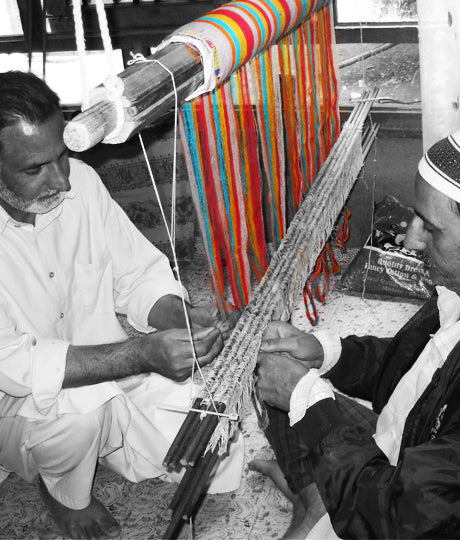
Warp dresser called Bharangur threading cashmere yarn through the heddles of a traditional Kashmir handloom Step 05
Dressing the Loom

Threading the Saaz — the Warp Dresser's Art

Before the warp can be mounted on the handloom, it must be "dressed" — each thread individually passed through the heddles of the loom. This is performed by a specialist craftsman known as a Bharangur.

The loom itself is called a Saaz in Kashmiri. Dressing the warp requires precision and patience — a single misthreaded yarn at this stage will create a flaw that runs the entire length of the finished cloth.

Kashmiri term Bharun — the dressing process; Bharangur — the warp dresser; Saaz — the handloom
Cashmere yarn being wound onto wooden spindles called prech in Kashmir before weaving Step 06
The Yarn

Winding the Weft Yarn onto Wooden Spindles

The weft yarn — the thread that runs across the width of the cloth as the weaver works — is wound onto small wooden spindles called prech. The starchy yarn is first dried in sunlight to stabilise it before winding.

Each spindle holds only a small amount of yarn, requiring the weaver to regularly reload during the weaving process. This seemingly small step contributes to the slow, meditative rhythm of handloom weaving.

Kashmiri term Tulun — the yarn-winding process; Prech — the small wooden spindles used
Kashmir weaver called Wovur working at a traditional handloom using hands and feet simultaneously Step 07
The Weaving

The Wovur at Work — Hands and Feet in Concert

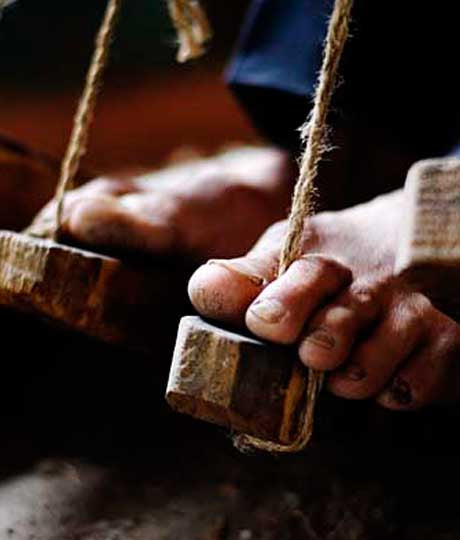
The weaver — called a Wovur in Kashmiri — operates the handloom simultaneously with both hands and both feet, like a pianist. The feet control the heddle pedals that raise and lower alternating sets of warp threads; the hands throw the weft shuttle and beat each thread into place.

A single Pashmina stole takes 3–4 days of continuous weaving. A complex Jamawar embroidered shawl can take months. A Kani weave — where hundreds of small bobbins replace the shuttle — can take 12 to 18 months for one piece.

Kashmiri term Wonun — the weaving process; Wovur — the master weaver
Kashmir specialist washer washing a finished Pashmina shawl in spring water, striking it against a smooth stone Step 08
Finishing

Washing in Spring Water by a Master Washer

Once the weaving is complete, the shawl is passed to a specialist washer. The final wash is carried out in fresh spring water using mild detergents, with the fabric repeatedly struck against a smooth stone to open up the fibres, improve the drape, and activate the natural softness of the pashm.

This process — which sounds harsh — is what gives a Kashmiri Pashmina its characteristic buttery softness. Machine washing cannot replicate it. The washer's skill lies in knowing exactly how long and how hard to work each cloth.

Master craftsman called Voste making the fringes and approving the embroidery design on a Kashmir Pashmina shawl Step 09
The Final Touch

The Voste — Making the Fringes & Final Approval

The finishing master — called a Voste — is the final quality arbiter of every shawl. It is the Voste who approves the design, requests changes if necessary, and passes the cloth to the embroiderer with a colour-matched specification.

The Voste also makes the fringes — the knotted ends of the warp threads that finish the shawl. Well-made fringe work is considered a mark of quality and is inspected closely by those who know what to look for in genuine Kashmiri work.

Kashmiri term Voste — the master finisher and quality approver
Close-up of a Kashmir Pashmina shawl being woven on a traditional handloom — the warp and weft threads clearly visible
"The weaver works like a pianist — simultaneously controlling feet pedals and hand shuttles, reading the pattern from memory."

The Complete Process of Making a Kashmir Pashmina Shawl

Making an authentic Kashmir Pashmina shawl is one of the most labour-intensive textile processes in the world. From the collection of raw pashm fibre in Ladakh to the final fringe-tying in Srinagar, a single plain-weave stole involves at minimum seven distinct specialist craftsmen and takes 3–4 days of weaving alone. An embroidered shawl can take months; a Kani shawl, years.

What Makes Kashmir Cashmere Different?

The Changthangi goat produces cashmere fibre averaging just 12–16 microns in diameter — finer than the finest Mongolian cashmere sold by most international luxury brands. This fineness is the result of the extreme altitude and climate of the Changthang plateau in Ladakh, where the goats graze. It cannot be replicated by selective breeding alone; the altitude and cold are essential.

Why Handloom Weaving Cannot Be Replicated by Machine

Pashmina fibre is too fine and fragile for industrial looms. Machine tension breaks the fibres. Only a hand-controlled wooden loom — the Saaz — operated by a trained Wovur can maintain the consistent, light tension that preserves the fibre's integrity throughout the weaving process. This is why genuine handloom Pashmina feels categorically different from machine-made "cashmere" blends: the fibres remain intact and the cloth drapes with a fluidity that machine-made cloth cannot achieve.

How to Identify Genuine Kashmiri Pashmina

Genuine handwoven Pashmina will show slight irregularities in the weave visible under close inspection — these are not flaws but evidence of the human hand. The cloth will be exceptionally light for its warmth. When held to the light, the weave will appear open and even. A genuine shawl can be folded into a jacket pocket. If a "Pashmina" is machine-washable, uniform in texture, and very inexpensive, it is almost certainly a blend or a synthetic imitation.

Every Pure Kashmir shawl ships with a certificate of authenticity and is backed by a no-questions-asked money-back guarantee on genuineness.

Wearing the Work of Many Hands

Each Pure Kashmir shawl carries the labour of herders, dyers, warp-layers, weavers, washers, and finishing masters. Shop the collection and own a piece of living heritage.

Shop Cashmere Pashmina Shawls